Assassin’s Creed Black Flag Resynced Details PS5 Pro Upgrades Ahead of July Launch
Ubisoft has detailed Assassin’s Creed Black Flag Resynced on PS5 Pro, with expanded ray tracing, PSSR, strand-based hair, dynamic weather, upgraded ocean tech, HDR, Dolby Atmos, an
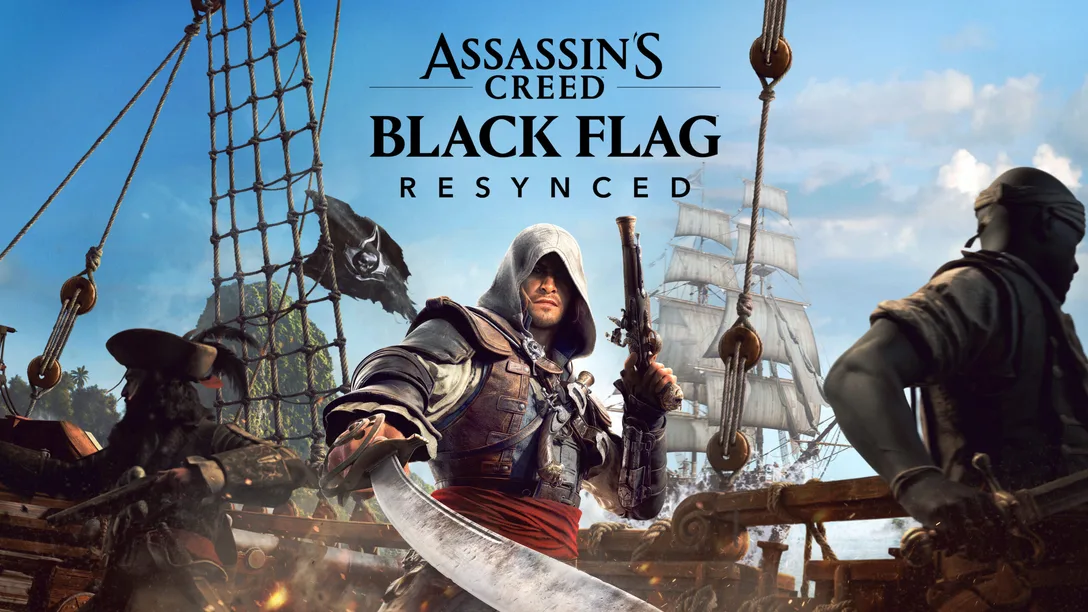
Ubisoft has detailed the PlayStation 5 and PS5 Pro enhancements for Assassin’s Creed Black Flag Resynced, launching July 9, 2026. The rebuilt version of Assassin’s Creed IV: Black Flag adds modern Anvil engine tech, 60 FPS options, HDR, Dolby Atmos, DualSense
Ubisoft has shared a technical deep dive for Assassin’s Creed Black Flag Resynced, the modern rebuild of Assassin’s Creed IV: Black Flag coming to PlayStation 5 and PlayStation 5 Pro on July 9, 2026. The PlayStation Blog post was published on June 29, 2026, with details from Ubisoft Technical Architect Nicolas Lopez and Technical Director Jussi Markkanen.
The main message is that Ubisoft is treating Resynced as more than a standard remaster. The team says the game has been rebuilt from the ground up on the latest version of the Anvil engine, with nearly every system modernized while aiming to preserve the identity of Edward Kenway’s Caribbean adventure. The new version includes 60 FPS options, HDR support, Dolby Atmos, DualSense haptic feedback, and multiple graphics modes for PS5 and PS5 Pro.
A major focus is lighting. Black Flag Resynced uses fully dynamic lighting powered by hardware-accelerated ray tracing, replacing the older approach of relying on precomputed lighting. That means interiors, weather, time of day, and environmental changes should react more naturally in real time. Ubisoft says Ray-Traced Global Illumination is enabled in all graphics modes on both PS5 and PS5 Pro, while Ray-Traced Specular Reflections are available in Balanced and Fidelity modes on base PS5 and across all graphics modes on PS5 Pro.
For players, that could make the Caribbean feel more responsive moment to moment. Black Flag is a game built around transitions: sunlight hitting the deck of the Jackdaw, storms rolling over the sea, wet wood after a fight, jungle shade, metal reflections, and ocean spray during naval combat. Better ray tracing is not just a screenshot feature here; it supports the game’s core fantasy of sailing through a living, shifting world.
Ubisoft also highlights a new Micropolygon geometry pipeline, designed to reduce visible level-of-detail popping. Instead of swapping between fixed asset versions as the camera moves, the engine continuously refines geometry based on distance, visibility, and perspective. Ubisoft says this approach is enabled by the PS5’s ultra-high-speed SSD, allowing Anvil to stream and render tiny geometric clusters smoothly.
That is especially relevant for an open-world pirate game. Players spend a lot of time looking across long distances: islands on the horizon, ship silhouettes, towns, forts, beaches, cliffs, and jungle edges. If Ubisoft’s system works as described, the world should feel less like it is visibly assembling itself as the player sails closer.
The biggest PS5 Pro-specific upgrades center on stronger ray tracing, image reconstruction, and hair rendering. Ubisoft says PS5 Pro players get extended ray tracing support across all graphics modes, including both Ray-Traced Global Illumination and Ray-Traced Specular Reflections. The PS5 Pro version also supports the latest PlayStation Spectral Super Resolution, or PSSR, to improve reconstructed image quality and narrow the visual gap between performance and fidelity modes.
Character rendering also gets a PS5 Pro boost. Ubisoft says strand-based hair is available for Edward in all PS5 Pro modes. In Fidelity mode, nearby crowd characters can also use strand simulation during gameplay, while cinematics use strand-based hair for all characters regardless of mode. That may sound like a small detail, but in a game filled with wind, storms, sailing, crowds, and cinematic close-ups, hair and cloth simulation can contribute a lot to the overall sense of motion.
Weather and ocean simulation are also being rebuilt. Ubisoft describes Atmos, its Anvil weather framework, as a system that simulates temperature, humidity, wind, and vapor density over time. Wind affects clouds, storms, vegetation, cloth, particles, sails, and character hair. The ocean has also been modernized with physically based rendering, new tessellation, volumetric foam, and dynamic bubble systems that react to wind, weather, and ship movement.
That matters because the sea is not just background scenery in Black Flag. It is the road, the battlefield, the mood-setter, and one of the main reasons the original game stayed popular for more than a decade. A stronger ocean renderer could make naval combat, exploration, and storm encounters feel more dramatic without changing the structure players remember.
What Ubisoft has not detailed in this PlayStation Blog post includes the full list of graphics mode resolutions, exact frame-rate targets per mode, install size, upgrade pricing, save-transfer support, accessibility additions, or whether the same technical features apply equally to other platforms. The article is focused specifically on PlayStation hardware, especially PS5 Pro.